Shape operator for triangle meshes
Usage
shape_op = ShapeOperator(input_mesh)
shape_op.run()
print(shape_op[3]) # A 2x2 matrix representing the shape operator at vertex #3
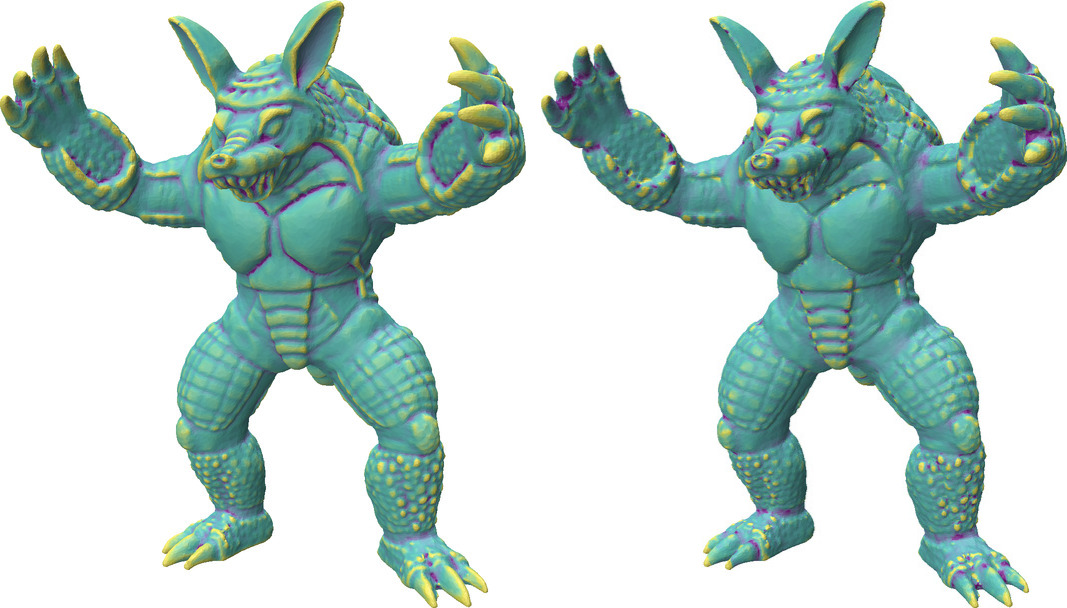
ShapeOperator
Bases: Worker
Computes the shape operator at each vertex of a triangle mesh. The method is based on least-square fitting of a second order polynomial to a neighborhood of points near each vertex. The size of this neighbordhood can be specified in the .run() method to vary the amount of smoothing.
Parameters:
| Name | Type | Description | Default |
|---|---|---|---|
mesh
|
SurfaceMesh
|
The input surface mesh. Should be triangulated. |
required |
verbose
|
bool
|
Verbose mode. Defaults to True. |
True
|
Attributes:
| Name | Type | Description |
|---|---|---|
shape_op |
ndarray
|
a Vx2x2 array containing the 2x2 shape operator matrix for each vertex |
References
[1] Estimating Differential Quantities Using Polynomial Fitting of Osculating Jets, F.Cazals & M.Pouget (2003) [2] https://github.com/alecjacobson/geometry-processing-curvature
gaussian_curvature
property
Gaussian curvature estimator at each vertex. Defined as the determinant of the shape operator. The values are weighted by the local areas around each vertex.
Returns:
| Name | Type | Description |
|---|---|---|
ArrayAttribute |
ArrayAttribute
|
Gaussian curvature as one float per vertex |
mean_curvature
property
Mean curvature estimator at each vertex. Defined as half the trace of the shape operator.
Returns:
| Name | Type | Description |
|---|---|---|
ArrayAttribute |
ArrayAttribute
|
Mean curvature as one float per vertex. |
run(patch_size=3)
Runs the computation of the shape operator for each vertex.
Parameters:
| Name | Type | Description | Default |
|---|---|---|---|
patch_size
|
int
|
max number of edges that separate the central vertex to a considered neighbor. Higher values mean that the polynomial approximation is fitted onto a larger neighborhood of the point, providing more stability but smoothing out the result. Defaults to 3. |
3
|